Kp index (NOAA SWPC)
The planetary geomagnetic index, 0–9. Your location's magnetic latitude decides the threshold: London needs Kp 7, Tromsø only needs Kp 3.
Reading the sky…
City-specific Kp forecast, cloud cover graph, and the best night of the week.
The planetary geomagnetic index, 0–9. Your location's magnetic latitude decides the threshold: London needs Kp 7, Tromsø only needs Kp 3.
Hourly total cloud at your coordinates. Below ~30% is fine; above 80% usually blocks the show.
Above 70% illumination washes out all but the strongest Kp. Below 30% is essentially "extra dark".
Astronomical twilight ends when the sun is 18° below the horizon. Earlier sunset ≠ earlier aurora.
From our pre-computed Bortle grid. Class 4–9 cities need stronger Kp to see anything.
Short-term (under 3 hours) is the most accurate. The 27-day outlook from NOAA is research-grade — useful for planning, not for promising a show.
Part of the night will work but a single factor (cloud, moon, twilight) is hurting. Open the breakdown to see which.
No — no signup, no app install, no account, no email collection. We count anonymous visits with Google Analytics and Google AdSense serves the ads; both are spelled out on the privacy page.
We use a public IP geolocation service. If you share a corporate VPN or mobile carrier, the result can be off. Use the city picker at the top of the page to override it, or hit "Use my location".
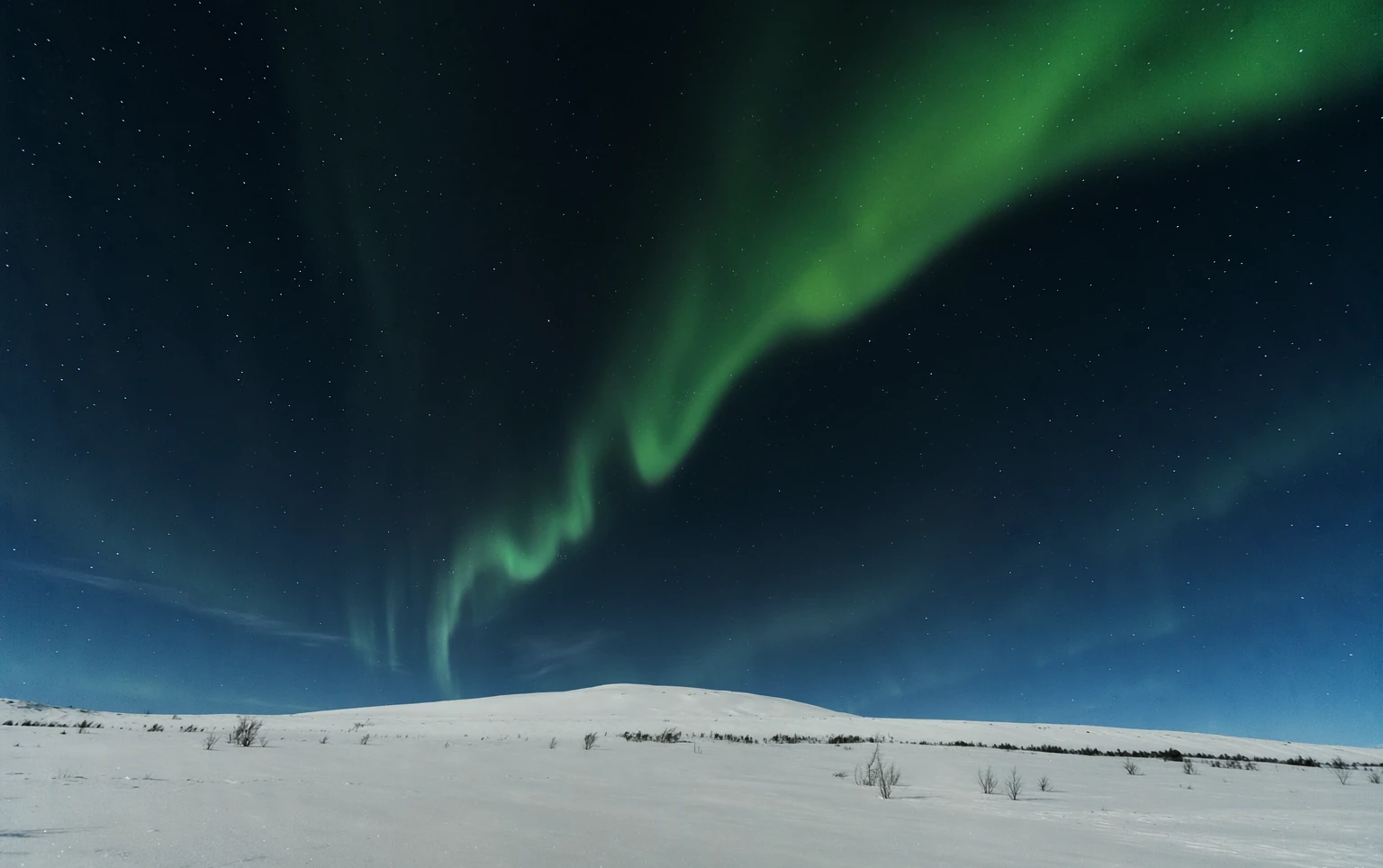
The aurora borealis — and its southern twin, aurora australis — appears when charged particles from the Sun (the solar wind) collide with gases in Earth's upper atmosphere. The colour depends on which gas is hit and at what altitude: green from oxygen around 100–300 km, red from oxygen above 200 km, blue and purple from nitrogen lower down.
What you actually see depends on three things: how strong the solar wind is when it hits Earth's magnetic field, how dark your sky is, and whether clouds get in the way. We track all three in real time and combine them into the single answer above.
The Sun rotates on its axis every ~27 days. Active regions (sunspots, coronal holes) often persist across one or two rotations — that's why NOAA publishes a 27-day outlook. Use it to spot windows of opportunity, not promises.
We are inside the most active period of the current ~11-year solar cycle. More sunspots means more frequent and more intense geomagnetic storms. Autumn 2026 is statistically the best viewing window for the next 12 months.
Tromsø in under 4 hours — plus Iceland, Abisko, Lapland.
Reykjavik, Fairbanks, Yellowknife — routes that actually work.
Rovaniemi via Helsinki, Fairbanks across the Pacific.
The southern lights: Tasmania and New Zealand.
Tromsø, Reykjavik, Rovaniemi — the equinox windows.
Whitehorse in 2.5h — the shortest aurora hop anywhere.